Tuesday, June 28, 2005


James A. Bretney Posted by Hello

To the Patriot

The word patriot means one who loves and supports his country. Latin in origin, it means literally father. One argues that civilization arises from writing. Though I believe writing and knowledge fundamental for civilization, civilization’s true bedrock is fatherhood, if you know your father then you are a civilized man and live in a civilized society. A patriot loves his father that love for his father manifests itself in the love of his country – the fatherland.

In war and peace, I have come to know many patriots and if I could echo those words of author James Michener in his book The Bridges of Toko-Ri “Where did we get such men?”

Consider the tales of a Montana mechanic, in the service of Brown Bess, Specialist Joshua Hope, who came to us by way of the 173rd Airborne Brigade out of Italy. Over a couple of beers last night, he told us of the demise of at least four friends of his that died in the service of our country in Iraq. 1LT Burmeister, a Citadel graduate, the Charlie company Executive Officer, 25 years old, made a reputation for himself amongst the men for attending to their material needs. 1LT Burmeister had been ambushed in the early days of the insurgency. He administered first aid to his driver, before falling over himself dead. Josh said he looked and looked for the bullet hole that entered the HUMVEE that killed 1LT Burmeister. He found that hole. It went through the air vent and hit his femoral vein. Josh had to clean all seven pints of blood of Burmiester’s blood from the HUMVEE. Another man he told us about drove a fuel truck, pushed his driver out of the truck, drove the fuel off the road, before he got out of the burning fueler – that man lost his fingers in the burns.

One such man whom I’d like to pay tribute to is my friend Staff Sergeant Robert A. Burd, former resident of Houston, Texas. I had known Rob in obscurity in the halcyon days that proceeded September 11th. We became fast friends as he had just come from the 82nd Airplane gang and I had just left 75th Ranger Regiment. The Balkans had been the hot spot back then. Rob talked about his first deployment. A wet behind the ears private with less than a few weeks at Fort Bragg, North Carolina, this teenage Texan came face to face with ethnic cleansing. He had seen the bodies stacked on top of each other, decaying and unearthed for the world’s judgment. Rob told me from time to time even after many years have passed those memories still visit him in his nightmares.

Why am I telling you all this? I am telling you this because Rob was whom I thought of when I read a recent article in VFW’s membership magazine about Veteran’s organizations springing up on campuses all across America.

The article assured its reader’s of the VFW’s commitment to the veterans of the Afghan and Iraqi wars. But the article caused me to reflect on my school daze and further ponder what affect this war will have on our society as well as what legacy had the Vietnam veterans left for us.

I don’t have a lot of respect for those who have never served. I meet them everyday. They buy drinks at the bar. They shake my hand. They tell me “Thank you.” But when I ask if they had served in Vietnam, they shrink and make excuses. Others more my age will praise my service and think themselves novel for becoming acquainted with the soldier and his exotic exploits. But these men whether they be supporters or its detractors must live with the shame that somewhere over there or over here a woman or an old man is carrying a rifle and doing their fighting for them. I can not tell you how many National Guard Specialists and Sergeants I have met with an M4 rifle slung across their chest and talk of their grandchildren while this metro sexual respective chicken hawks and treacherous cowards drink heartily from comfort’s cup. It disgusts me to see an able bodied male with long hair while in a military hospital somewhere a woman works with a physical therapist to get use to her prosthetic arm or another woman works with a counselor about how she cannot relate to her son because she could not avoid killing a boy his age on convoy.

The article cited military veteran’s discipline, cordial manner and natural leadership skills necessary for collaborative academic environments. But I wonder when will Rob get his chance to lead a discussion on nineteenth century nationalism, work through his computer science proof, or build a solar car when now he’s either coming back from or getting ready to go for his fourth tour to central Iraq?

When I think about our future impact, I think it could be good or ill, it depends on the war. Riding the Martian chariot can take you to the heights of power or into a dark age of slavery and vice. Consider that no European nation had ever been the same since the end of the First World War. Their peoples had given themselves over to the tyranny of vogue intellectual debauchery – communism and fascism. And what of us, Korea and Vietnam signaled perhaps that we were in decline, the 444 day hostage crisis – though not a war, an act of war broadcasted our debility prior to the advent of President Ronald Reagan.

If the war goes well, we will walk toward a new dawn. If we falter and listen to fork tongued demagogues who call the war a quagmire and a mistake without the benefit of military service or an honest assessment of our military operations in Iraq, then darker days loom ahead. As the Polish invited the Teutonic knights as mercenaries to defend their liberty, perhaps this all volunteer force will evolve into a military class taking a Heinlein view of citizenship and either by moral force or by coup d’etat establish a medieval order as older civilizations strive to remake a multi-polar world.

I want to honor the Vietnam veterans of my father’s generation. They are a moderating influence on the wild excesses of the now repentant Jane Fonda’s of that evil generation. They served in the most wretched circumstances undertook a noble crusade that proved thankless and vain because the people they served were not worth the blood they spilled. I always looked to the Vietnam veterans as my heroes. I want to thank my Uncle John and Uncle Douglass for their service. And I want to thank my Dad.

The national prestige of nation is measured by the quality and quantity of its patriots, the annuals of history, those annuals unrevised by recent scholarship, attest to this. We must have soldiers, soldiers and more soldiers. If our culture does not encourage the free exercise of patriotism in public life, then on the hooves of the four horses of the Apocalypse will come our last hour, our imminent Gotterdammerung.

Saturday, June 25, 2005


James A. Bretney Posted by Hello

Immigration Revision: On National Security

for Andy

In light of a recent confidential report of confirmed Al Qaida elements operating across the border in Mexico, I must revise a previous opinion I wrote regarding the Immigration issue.

I do not object to checkpoints or even volunteer patrols to secure our border. The fact is that we are at war and the war has come to our lands. Just as President Franklin Delano Roosevelt protected our country from Japanese spies and German saboteurs, we must protect ourselves against those that would do us harm. From experience, I can tell you that albeit with distinct nuances it can be very difficult to differentiate an Arab from a Mexican American.

The President walks a very fine tightrope balancing national security and in the interests of the Latin community whose contributions to our society are still being felt and are quite substantial. Al Qaida operators killed Americans of Latin descent like myself in the World Trade Centers, in Iraq and Afghanistan. We must assure ourselves that we have taken every precaution against this threat. That interest above all else unfortunately and no matter how distasteful is our first and most sacred duty.

As my friend has wisely counseled me, this effort will require the cooperation of other Latin American governments. We cannot afford to alienate these governments by abusing their citizens who enter this country legally or illegally. I applaud volunteer efforts to ensure the lives and well being of émigrés from Latin America coming to seek a better life. The deaths of those whether in the desert or those discovered three weeks after their death by suffocation in train cargo cars or in the backs of abandoned Ryder trucks will only damage and alienate our interest in the Monrovian hemisphere.

I would also like to remind everyone that El Salvador is an ally and has combat troops on the ground in Iraq.

We have the right and should exercise the right to arrest and deport those who break the law. It would behoove us to use common sense for long time residents who have lived in this country illegally but have otherwise lived law abiding lives, paid taxes and made contributions to our polity. I endorse the President’s guest worker plan as a first step at tackling the desperation of the plight of Latin America. Money orders sent from guest workers represent the largest influx of foreign currency to Latin America.

Perhaps in addition to the President’s generous proposals for increased immigration, we should take steps to go after employers who hire illegal immigrants knowingly for the purpose of keeping them in some kind of wage slavery. The District Attorney under then John Ashcroft and now Alberto Gonzalez has broken up sex trade route operated by Russian and Chinese syndicates. Such efforts would reassure Latinos that they aren’t the subject of sleight of hand anti-catholic nativism.

With respect to the Honorable Tom Tancredo’s of the world, though I don’t agree with what he saying, I respect the man for having the courage to say what’s on his mind. You look at a guy like Rick Santorum or the late Paul Wellstone, and you say to yourself, “I may not agree, but at least I know where he stands on the issue.”

We would be wise to publicize as much as possible arrests of Al Qaida agents crossing our border, camps in Mexico and Latin America and cooperation between our government and other governments within the western hemisphere. Perhaps this cooperation tied with trade specifically developing oil wells within the Gulf of Mexico could lead to greater cooperation in the drug trade and increased economic prosperity within NAFTA and CAFTA.

http://www.washtimes.com/national/20040928-123346-3928r.htm
http://www.cnn.com/2005/WORLD/americas/06/22/mexico.terror.ap/?section=cnn_latest
http://www.boston.com/news/world/latinamerica/articles/2005/06/23/suspect_in_sept_11_attacks_held_by_mexico/

Friday, June 24, 2005


James A. Bretney Posted by Hello

Confirm Ambassador Bolton Now!!!!

Nominate John Bolton

In another example of why the Senate should re-examine the filibuster’s tradition in the hallowed Chamber, Democrats, the Party of No, twice blocked the nomination of John Bolton, the President’s nominee to as U.S. Ambassador to the United Nations. Barring some compromise, the President may have to withdraw the nomination or appoint him to fill temporarily. In that case, the Senate would revisit the issue when his temporary appointment expires – January of 2007. I urge you the reader to browbeat the Senate to into compromise and appoint him. Should that fail, we should support the President’s temporary appointment.

The Press has billed Mr. Bolton as not a nice guy. Detroit Free Press in its June 23rd editorial has written: “John Bolton, with his record of disdain for the United Nations and a temperament that has been repeatedly described as something less than diplomatic, is simply the wrong person for this sensitive post.” The Indian Country Today offers a more scathing look at the man who would be the US at the UN, alleging that Bolton made up accusations against Cuba in 2002 and Syria in 2003 about their bio-weapons program. Further, the critics cite that Bolton attacked Mohamed El Baradei’s reappointment to the UN’s International Atomic Energy Agency (IAEA) and has been particularly harsh to the North Koreans. From the Indian Country Today: “Lawrence Wilkerson, a retired Army colonel who was former Secretary of State Colin Powell's chief of staff from 2002 to early 2005, testified that Bolton's temperament and ill treatment of subordinates caused major tension and resentment at the highest levels of the State Department. . . . Wilkerson opined that Powell thought Bolton ‘an extremely poor leader’ and ‘not an effective diplomat.’” Then there’s the much sexed-up harassment damsel in distress song and dance that Ms. Melody Townsel, a subcontractor of a U.S. Agency for International Development (USAID) project in Kyrgyzstan offered before the confirmation hearings: ''Within hours of sending a letter to USAID officials outlining my concerns [over poor practices by a contractor], I met John Bolton, whom the prime contractor hired as legal counsel to represent them to USAID. And, so, within hours of dispatching that letter, my hell began. . . . Mr. Bolton proceeded to chase me through the halls of a Russian hotel - throwing things at me, shoving threatening letters under my door and, generally, behaving like a madman. For nearly two weeks, while I awaited fresh direction from my company and from USAID, John Bolton hounded me in such an appalling way that I eventually retreated to my hotel room and stayed there. Mr. Bolton, of course, then routinely visited me there to pound on the door and shout threats.''

So Ambassador Bolton is not a nice guy. On the surface, he does not appear to be very functional as a human being. Not exactly easy on the eyes, one might call Ambassador Bolton a name that rhymes with flagpole. But he’s precisely the right man for the job.

The UN needs a pit bull right now not a smooth silk stalking slick tongued ninny whose afraid to call a spade a spade because he’s afraid to offend someone. To paraphrase from the Arizona Republic, sometimes UN Ambassadors, Jeanne Kirkpatrick, Daniel Patrick Moynihan and even Adlai Stevenson need to be tough. We need someone to call terrorism and genocide what it is in Darfur – terrorism and genocide. We need someone to raise the steer manure flag when the UN declares as it did in 1975 that “Zionism is racism.” For those who defend the UN, where was the UN in West Africa when its own peacekeepers sexually abused the people it was trying to protect, where was the UN at the Hotel Rwanda, and where was the UN on the 17 billion dollar Oil for Food bribery scandal?

With all due respect to the General who argued in favor of leaving Saddam’s army in tact in 1991, someone with a confrontational bent and someone who puts America’s interests first is exactly what the UN needs. Most American see the United Nations, an institution we created as a harbor for anti-Americanism. As Peter Brown of the Orlando Sentinel has pointed out, Americans pay “22% of its $1.1-billion operating budget [and] 27% of the money it is spending on peacekeeping.” A lot of as are wondering what kind of return on our investment we are getting. Hey but the headaches are free, right?

We need someone who is going to kick a little tail in the UN. The best form of diplomacy is one grounded on straight talk. The fact is the UN has had Negroponte and Powell to contend with, let’s see what they will do with a Bolton.

Friday, June 17, 2005

When the East Belonged to Christ

When I was a boy, my mother circulated these prayer cards in house and presumably she got them from our local parish. Emblazoned on these prayer cards stood prominently the visage and gilded form of Our Blessed Mother who entreated us in small script on the bottom: “Pray for the Conversion of Russia.” The inner critic scoffed at such a ridiculous idea, that the heathen hordes of the Soviet juggernaut could be won over by feebly mumbled prayers spoken in darkness with the dim candlelight to guide it. Yet lo and behold, in my lifetime, before I reached manhood, the Berlin Wall fell and the Soviet Union joined its rightful place with the rest of the Baals on the ash heap of history.

I consider such a sentiment today when we confront the Muslim in our clash of civilization. In our interdependent world, we often cut ourselves on Islam’s bloody borders.

The “I Hate America” crowd, Islamists and their European and American allies equate our invasions of Iraq and Afghanistan to the Crusades. Their memory selects the Crusades, a brief time in which chivalric knights sought to liberate the Holy Land from the Saracen yoke to the fourteen century jihad bent on world domination.

But in their myopia, these nipping dogs forget a time when the Orient belonged to Christ.

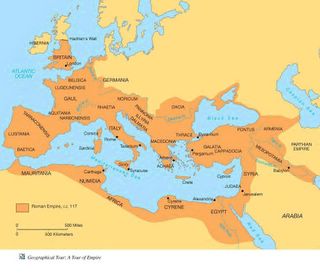
Christianity in the Roman World (30 AD - 313 AD) Posted by Hello
From the time of Christ until the fall of the Roman Empire 313 A.D., the missionary zeal of ordinary people, particularly those who traveled - soldiers, traders, muleteers and diplomats - spread the persecuted faith throughout the far corners of the Empire – a land encircling the Mediterranean or Middle Sea. The Church established itself as a state-within-a-state performing acts such as aiding the needy, educating the children, and adjudicating disputes.

http://www.encyclopedia.com/html/section/Constnt1Rom_RisetoPower.asp

In 313, a Roman claimant to the throne of the Julii saw in the sky a flaming cross and the words “by this sign you will conquer.” This Roman, Constantine, embraced Christianity, emblazoned the Chi Rho – the Greek symbol of Christ on the shields of his armies, conquered his enemies and became Emperor. Constantine declared Christianity the state religion.

http://www.newadvent.org/cathen/02084a.htm
http://www.newadvent.org/cathen/08341a.htm

Men like St Jerome (340-420) who spent most of his life in a monastery in modern Syria and author of City of God, St Augustine (354-430), a Northern African from Hippo on the outskirts of Carthage located in modern day Bizerta, Tunisia shaped Christianity throughout the modern age.

http://www.newadvent.org/cathen/11549a.htm

By 451 A.D., the state religion of the new Roman Empire had patriarchs, Jerusalem, Antioch, Alexandria, Constantinople and Rome, with Rome having primacy.. Today, though Jerusalem is under Jewish control, three of the five cities – (Antioch in Syria, Alexandria in Egypt and Constantinople renamed Istanbul in Turkey) of the patriarchate remain in the hands of the Muslim.

The Acts of the Apostles Posted by Hello

India

India

http://www.newadvent.org/cathen/14658b.htm

We owe an enormous debt to a man history has dubbed as the “doubting Thomas.” [/i][/url] According to Marco Polo, Saint known by his Syriac name of Didymus or twin drew the lot for India and decided that he would not go to India. Following this decision and taking his leave from the twelve, Saint Thomas had been ambushed and sold into slavery. His master, the Rajah of Bokhara, a region encompassing the modern states of Afghanistan, Baluchistan, the Punjab, and Sind, wanted a carpenter and commissioned his new servant to build for his master a new palace. Saint Thomas used the money to give alms to the poor. The incensed Rajah threw Saint Thomas into prison by which he escaped. The miraculous escape evoked a conversion from the Rajah.

Legend has it that Saint Thomas made his escape to Malabar on the coast of India where Christians in communion with the Holy Father in Rome practice a rite of Christianity in the Syriac tongue. In the 1500’s, these Malabar Christians embraced their Portuguese brethren until the sea faring Portuguese tried to enslave them. Malabar Christians still exist today in India yet not many Christians inhabit the modern lands of Thomas’ former master. Less than three percent of Pakistan’s inhabitants are Christians. Similar statistics can be found in Central Asia.

Ethiopia and Nubia

Ethiopia and Nubia

http://www.newadvent.org/cathen/05566a.htm
On the border of the Arabian peninsula, the geographic heart of Islam, stood the land of the Biblical Cush, named after the grandson of Noah. The Cush later to be called the Kingdom of Axum had been yoked to the Hebrew religion since the days of Queen Sheba and King Solomon. Christianity came to the modern Ethiopia (whose name is derived by the Greeks as the land of the scorched faces) in the fourth century by way of piracy. Red Sea brigands seized a cargo ship bound for India and put every man, woman and child to the sword except for two boys Edesius and Frumentius nephews of the recently deceased Merope of Tyre. The pirates sold the Christian boys to the pious Jewish King of Axum. The two boys won favor with the King who subsequently converted to Christianity. One of the boys Frumentius desired greatly to sit on the Episcopal chair of Alexandria. Having achieved that, Saint Frumentius returned to Axum and organized the Church there having received the appellation Abba Salama – Arabic for Father Peace.

Though Christianity still holds sway over most of modern Ethiopia, she maintained her independence through force of arms and not without ceding territory to the Saracen. Muslims have buffer states in Eritrea and Somalia.

http://www.newadvent.org/cathen/11147a.htm
Nubia, whose name in Egyptian means gold, though would no doubt be familiar with the mystery of Christ since Calvary did not accept the faith until she received protection from the Byzantine Empress Theodora in the fifth and sixth centuries.

Through a combination of conquest and amalgamation, Nubia has gone over to the Arab Muslim who continues to oppress his Christian and Animist countrymen. The Christians reside in the southern mineral and petrol rich south. The Islamic government backed by corporate sponsors from Sweden, Canada, Austria and China have slaughtered two million and displacing another three million.

Persia

Persia

The Romans, taking the torch of the Hellenes, vied with the Persians for control of the cradle of civilization setting up buffer states based on treaties that reflected the military balances sheets from the fortunes of war. These buffer states in modern day Palestine, Jordan, Syria and Iraq reflected the influences of the two competing civilizations. The Persians, who do not speak a Semitic language, but speak an Aryan language, who many believe to be the linguistic father of most modern European languages wrote in cuneiform and worshipped their own religion, Zoroastrianism. Nonetheless, before the first Arab Muslim army set foot inside Persia, Persian Christians erected churches and even had several archdioceses.

Despite early four centuries of Christian persecution by Persia suspecting the Syriac speaking missionaries to be agents of Rome, Christianity spread throughout the Persian provinces. A Persian nobleman, Aphraates, converted during a time of great Christian persecution. Under the leadership of Dorotheus, monasticism flourished despite the Persian capture of the Christian Roman outpost of Nisibis.

In the year 399, the Roman emperor appointed Maruthas, Bishop of Maiperkat, in Mesopotamia, to act as envoy to the Persian Court.

Maruthas befriended the Persian king, Yezdegerd, who in turn allowed the free spread of Christianity in Persia and the building of churches. Nisibis once more became a Christian city. The Persian Church developed and maintained and even at times increased its number and developed its organization until the period of the Mohammedan conquest.

The Bishop of Susa, an associate of Maruthas, Bishop Abdas terminated good relations with the Persian court by burning down heathen temples and balking when the Court demanded re-payment. The king gave the Zoroastrians a free hand by which they martyred Abdas and burned down all churches. At the end of Yezdegerd’s reign in 420, many Christians fled into Roman territories. Bahram V succeeded his father to the throne and prosecuted the persecution which erupted in war between the Empire and Rome. The war grew in scope and Roman victories in Armenia caused the Persians to ally themselves with the Turks. Nonetheless, the peace terms favored the Romans.

Though the next hundred years brought turmoil to the Eastern provinces, literary and ecclesiastical extension flourished. The turmoil became the fertile seedbed of a Syriac literature in Persia and ultimately of a Christian Persian literature.

Persia fought a war in the southern Caucasus as the Prince of Lasistan, a courtier of the Romans, converted to Christianity..

In 531, Chosroes I, “Chosroes the Just" ascended the throne and made peace with Byzantines, the Eastern Roman Empire, and declared a proclamation of religious tolerance. While campaigning in Syria, Chosroes took ill and under the inducement by Byzantine agents, Chosroes’s son, Nushizad by his Christian wife, sized the throne. Chosroes crushed the rebellion which mortally wounded his son, Nushizad, who repented of his rebellion against his father and received last rites from Mar Aba, a bishop of the Nestorian Christian sect.

Hormuz, Chosroes’ successor and son, (579-590) led the Empire into a degenerate tyranny and suffered invasion on the north, east, and west. A defeated general under a death sentence assassinated Hormuz and grabbed power for himself. Hormuz’s son escaped and with the aid of the Byzantine Emperor Mauritius defeated the upstart became king as Chosroes II. As he owed his kingdom and his wife to the Emperor Mauritius, Chosroes was loyal to the ruling house in Constantinople. Although not himself a Christian, he married a Christian, honored the Blessed Virgin and the martyrs Sergius and Bacchus, two saints popular among the Syrians.

In 604 the Emperor Mauritius himself was assassinated. The younger Chosroes resolved to avenge the death of his benefactor by seizing Syria, Palestine, Egypt and Asia Minor and threatened Constantinople. In 615, Chosroes put down the Jerusalem revolt by executing 17,000 persons, leading 35,000 into captivity and carrying off the fragment of the True Cross, the most precious relic of the city. Asia Minor remained in the hands of the Persians until 624.

Chosroes’ reign, however, did end in revolt. Chosroes the Younger, with a harem of 3,000 wives and 12,000 female slaves, demanded as wife Hadiqah, the daughter of the Christian Arab Na'aman. Na’aman’s refusal met with his death being trampled on by an elephant. His daughter, Hadiqah took refuge in a convent. The outrage led to a general revolt by all Arabs who later toppled the Empire.

Arabia

Arabia

At the time of Christ until Mohammedan dominance, the Persians, the Romans, the Egyptians and the Abyssinians (the modern Ethiopians), the major imperial powers at the time divided swaths of Arabia onto themselves. Nonetheless, this backwater, that would later become the most important kingdom in Islam.

The Arabs are Semitic people whose Biblical birthplace Ur is less than a hundred miles south of Modern Baghdad. Abraham’s father, Haran was an Arab and Abraham’s first born illegitimate son Ishmael, “the wild ass of a man” (Genesis 16:12) was an Arab who settled in modern Yemen where Osama bin Laden’s family hails from.

The Arabs for all their scarcity controlled the lucrative silk trade with China (Cathay) and with their triangular mast ships that caught the trade winds and because of piracy in the Red Sea had proved such a problem, merchants put their cargo onto camel bearing caravans across the vast wasteland of Arabia. The bedu or Bedouin, the desert dweller is something akin to the cowboy in our culture, rugged, independent, resourceful and courageous in war.

Though often confounding to scholars, Christian historians chronicle the mission to Arabia through the writings of Eusebius, Rufinus, Socrates, Nicephorus, Metaphrastes, Theodoret, Origen, and Jerome. Except for the remains of a fifth century church that had been converted into a heathen temple, little if anything remains in the way of monuments of literature. Nonetheless, Christianity in Arabia had three in centers in the north-west – a Roman province known as the Kingdom of Ghassan, north-east the Kingdom of Hira a buffer state under Persian sway, and south-west of the peninsula – the three kingdoms of Himyar, Yemen and Najran under Abyssinian domination. The central and southeast, such as Nejd and Oman, probably had knowledge of and a few followers of Christianity . Mohammed knew of Christianity. Christian influences persist throughout the Koran. Mohammed himself had been ministered by a Christian physician who assured him that he was crazy or possessed by the devil.

Christianity in the Roman Province of “Arabia Felix”

Problematic for most historians of this period is the lack of available sources for the Christian Arab. The bards who chronicled this period passed their traditions down orally. At the time of the rise of Islam, Muslim scholars recorded this oral tradition as late as the ninth century referring to this period as one of “anarchy and ignorance.” Nonetheless, we can divide the history of northwestern Arabia into three periods: the direct Roman rule until 261 A.D., the rebel kingdom of Palmyra (262-271), and the re-conquered Roman rule through the Ghassanid dynasty. The Romans called this region “Arabia Felix” or Happy Arabia and did so not so much to denote the disposition of the Bedouin, but to the wealth they controlled through their caravans that enriched the Nabataean kingdom whose architectural feat of Petra still stands as a monument to their genius of their culture. After failed expeditions to conquer the region under Pompey and Augustus, the Romans finally attained their prize by arming a fleet to compete directly with the Nabateans and campaigning during the monsoon months.

The rebel kingdom of Palmyra ably led by Queen Zenobia arose during a period of Persian strength and Roman debility due to Caesarean intrigues and assassinations. But the rebellion had been put down by the Ghassanids – a Christian tribe from Yemen who through conquest endeared themselves to their Roman masters.

Arabs had been present at Pentecost and the first Christian missionary to Arabia had been none other than the Apostle Paul who wrote: "Neither went I up to Jerusalem to them which were apostles before me; but I went to Arabia, and returned to Damascus" (Gal. I, 17) One suggestion about Pauline mission can be traced to the Koranic allusion to a certain Nebi Salih, or the Prophet Salih, who is said to have come to the Arabs preaching the truth and was not listened to, and who, consequently, in leaving them said: "O my people, I did preach unto you the message of my Lord, and I gave you good advice, but ye love not sincere advisers" (Surah vii). Since the persecutions of both the Roman and Persian of Christians appear particularly harsh, northern Arabia offered a safe haven during those periods of crisis. Christian Arabs became so numerous that Persian and Roman alike relied on Christian Arabs to protect their spice and silk caravans.

Evidence of the Christian influence over the region originates with Rufinus (Hist. Ecclesiastica, II, 6) tells us of a certain Arabian Queen Mu'awiyah, who, after having repeatedly fought against the Romans, accepted peace on condition that a certain monk, called Moses, should be appointed bishop over her tribe. Unfortunately for the Emperor Valens (about 374) had been an Arian and that Moses a hermit of the Egyptian desert refused to be ordained a bishop from the heretic Bishop Lucius of Alexandria. The Emperor had to bring an exiled Catholic bishop to procure the Bedouin queen’s request.

Christianity in Mesopotamian Arabia

Today as in antiquity, Al Anbar province has been a fertile seed bed of passionate religious activity. In modern times, the barren brown waste west of the Euphrates River to the Syrian border provides the Sunni insurgents its most fanatical followers. In antiquity, this austere region was a Christian stronghold in what would become modern Iraq.

Church fathers date Iraqi Christianity towards the first century with the settlement of Tenukh tribe led by Sheik Malik ibn Fahm followed by the Iyad, Azd, Qudâ'ah, and others tribes establishing a Christian Arab community in Hira, not far from the modern Kufa on the Euphrates. The blood of these martyrs at the hands of the Persians spread the faith throughout all of modern Iraq. The Persians called the Christians of Hira 'Ibâd, or "Worshippers.”

The first Christian king of Hira, which dominated the region politically and economically, King Nu’man reigned from 390 to 418. During his reign the Kingdom of Hira extended over all the Arabs of Mesopotamia, over Babylonia, along the Euphrates down to the Persian Gulf, and as far south as the islands of Bahrain. He built the two famous castles of Khawarnig and Sidir, celebrated in Arabic poetry for their unsurpassed splendor and beauty. The region produced one saint, the hermit Saint Simeon the Stylite who by his example converted many pagans into Christians.

Christianity amongst the Ishmaelites

African Judeo-Christianity owes itself in large part to a love affair between a man and a woman more than three thousand years old. When the Queen of Sheba gave herself to King Solomon, Judaism and later Christianity would safe and flourishing passage into modern Ethiopia which in turn spread the new faith to Egypt and North Africa, central and eastern Africa and across the pirate infested waters of the Red Sea into Arabia, Yemen – the land of the Ishmaelites a race of men whose father the Bible described as one “wild ass of a man.”

The King of Axum, at the time of Christ was Jewish and had been Jewish for quite some time. He sent missionaries and colonies across the straits into Yemen called Himyar and Abyssinians – the subjects of the kingdom of Axum who would become the modern day Ethiopians - enjoyed considerable influence. After the Roman destruction of the Second Temple in Jerusalem and the mass suicide at Masada, many Jews emigrated to Himyar escaping Roman persecution.

Saint Bartholomew traveled to Abyssinia and later to Yemen and won over many hearts to Christ. It may be of some note to consider that for the final thirty years following Christ’s crucifixion that the character of the Christian, the Pauline missions excluded were of a Jewish character.

In the second century, when the second great missionary Pantaenus, master of the school of Alexandria, arrived in Yemen, Pantaenus found Gospel of St. Matthew allegedly from the Apostle himself.

During the reign of Constantine, the third great mission to Himyar came from none other than Bishop Frumentius from Abyssinia who with many priests built churches and won many converts over to Christ.

In 356, the Byzantine Emperor Constantius sent Bishop Theophilus (Greek for lover of God), deacon of Nicomedia to Himyar with the express mission to protect Roman citizens in the free exercise of their religion. Bishop Theophilus won over the king that the king built three churches for them, one at Dhafar (or Safar), another at Aden or at Sanaa, and the third at Hormuz, near the Persian Gulf and according to Philostorgius, the king himself became a Christian.

In 523, the Christians suffered yet another persecution not by Persian or Roman pagans but by Jews in Najran under the Jewish King, Yusuf Dhu Nuwas.

Dhu Nuwas ordered a general massacre of all the Christians. "Large pits were dug in the neighbourhood and filled with burning fuel, and all those who refused to abjure their faith and embrace Judaism, amounting to many thousands, including the priests and monks of the surrounding regions, with the consecrated virgins and the matrons who had retired to lead a monastic life, were committed to the flames. The chief men of the town, with their prince, Arethas [called by some Arabian writers Abdallah ibn Athamir], a man distinguished for his wisdom and piety, were put in chains. Dhu Nuwas next sought their bishop, Paul, and when informed that he had been some time dead, he ordered his bones to be disinterred and burnt and their ashes scattered to the wind. Arethas and his companions were conducted to the side of a small brook in the neighbourhood, where they were beheaded. Their wives, who had shown the same constancy, were afterwards dragged to a similar fate. One named Ruma, the wife of the chief, was brought with her two virgin daughters before Dhu Nuwas; their surpassing beauty is said to have moved his compassion, but their constancy and devotion provoked in a still greater degree his vengeance; the daughters were put to death before the face of their mother, and Ruma, after having been compelled to taste their blood, shared their fate. When he had thus perpetrated the tragedy of Najran, Dhu Nuwas returned with his army to Sanaa." According to Ibn Ishaq, the number of the massacred Christians totaled 20,000, while the letter of the Bishop of Beth-Arsam recorded 427 priests, deacons, monks, and consecrated virgins, and more than 4,000 laymen.

The Dhu Nuwas massacre sent out an international outcry from Persia to Constantinople. The king of Abyssinia led a flotilla of seventy thousand men and invaded Himyar. They re-established religious control over the country but shortly after expelling the Jewish house, the Abyssinians were ousted by Himyarite patriots under a new leader who would become King Abramos.

King Abramos ruled over what would become the golden age of Ishmaeli Christianity. That golden age would be cut short in the year 570 A.D., Mohammed’s birth year and a time known to the Muslims as the “day of the Elephant.” The Ka’bah a religious temple for Arab pagans established in Mecca had been controlled by the Qur’aish tribe of which Mohammed was a member. King Abramos desiring to siphon off the lucrative Hajji traffic built a church in Sanaa that in size, scope and grandeur dwarfed the upstart Meccan dirge bowl. A criminal desecrated the church and King Abramos marched on Mecca with war elephants.

Abdul-Muttalib ibn Hashim, the grandfather of Mohammed and chief of the tribe entreated the King for peace which included one third of all the revenues collected from the Hajjis. King Abramos refused and marched on their mountain redoubts to his annihilation. The King himself died of wounds from the siege and his kingdom and the hope of Christianity in Southern Arabia died with him. Soon the Christians would feel Muslim mercy, conversion, slavery, death or deportation – the hallmarks Islamic tolerance - religious genocide.

Conclusion

The purpose of this article is not just to inform Christians, particularly American Christians of a long neglected period in the past but to argue for future missions political, economic, social, military and SPIRITUAL missions to a part of the world so desperate for peace that it can only come through Christ’s love. If we really want long term peace in the region, we must change the hearts of our enemies formed in the violent institutions of conformity and obedience that emanates from the teachings of the Prophet Mohammed. We must show the infidel that Christianity is more authentic and true to their native culture and pre-existing civilization than the newer and yet backward Islam.

Many nations that have ceased to exist anymore have been brought high and low casting their lots with the fortunes of war. Few of us are of military age, and further, in our national struggle for real change in the Middle East will thwart any direct and victorious military victory over one sixth of humanity. One critic of my first blog, “The New Crusade,” which argued for the cultural annihilation of Islam said how are we going to accomplish this realistically? You start with those prayer cards. It may help to put things in their proper historical context. But those prayer cards, circulate awareness. Awareness circulates action. Action could mean monies sent aboard, letters to the editor, your congressman. Action could mean that one of us could be called to be a missionary and if it is God’s will a martyr. Martyrdom like prayer cries out, just as the ill spilt blood – the blood of the good son Abel - cries from the soil. And God and only God will bring the Saracen to the civilized world if WE PREVAIL IN OUR FAITH!!!!

If this article prompts your faith to act beyond prayer, although prayers from all faiths and sects are welcome, then I suggest the following.

Contribute to the Archdiocese of Baghdad:
His Excellency Bishop Mar Sarhad Jammo Eparchy of Saint Peter the Apostle of San Diego of the Chaldeans 1627 Jamacha Way El Cajon, CA 92019 His Excellency Bishop Mar Ibrahim Ibrahim Eparchy of Saint Thomas the Apostle of Detroit of the Chaldeans 25603 Berg Road Southfield, MI 48034 Rt. Rev. Monsignor & Archimandrite Robert L. Stern Secretary General Catholic Near East Welfare Association 1011 First Avenue New York, NY 10022-4195

Contribute to the following charities and public policy institutes defending both Catholic and Evangelical Christians:

http://www.persecution.org/newsite/
http://www.freedomhouse.org/
http://www.cnewa.org/home.aspx

Contribute and support pro-Christian politicians concerned about the plight of our brothers and sisters abroad:
U.S. Rep. Frank Wolf, R-Va

http://www.house.gov/wolf/
http://www.wolfforcongress.com/

Wednesday, June 08, 2005

Our Energy Plan is our National Security

What does a smiling Rafsanjani of Iran, nukes, asymmetric warfare, and the price of gas in China have to do with the President’s Energy Plan? But before you ponder that, Hillary Clinton, who still has not indicated whether she will run for President, blasts Bush for not being green enough. Let's just cut the crap, the Energy Plan is our National Security. We should endorse the President’s Energy Plan because the next war will be over the price of oil in Iran, China, India or Russia. Failing to do so will weaken our geopolitical position should war erupt between those states.

In the winter of 1992, while a cadet in military school, I read a New York Times article endorsed by bipartisan defense public policy institute regarding our war doctrine. In contrast to the Cold War, recall that the Berlin Wall fell less than three years ago, our new war objective stated that the United States would maintain a posture that allowed for the successful prosecution of two wars one possibly on the Korean peninsula and another in Iraq. Asymmetric warfare and rogue states had been the key buzz word back then. Little did I know that eleven years later, I would find myself fighting yesterday’s war as a sergeant.

Even in 1992, the key words and all the trappings of conventional wisdom resonated with me about as much as President George H.W. Bush’s defense cuts with the kinder and gentler Congressional democrats of his term. The pundits wanted to say goodbye to love of Reagan Era heavy tank divisions and 600 ship navies seeing World War II style confrontations the stuff that lived only on the celluloid screens of the AMC.

What were they thinking? Did they think that wars would no longer be fought over control over natural resources just as new economy advocates touted the end of the business cycle? Protracted evenly matched opponents would need to divide the support of the “neutrals” within the international community for loans, materials and intelligence, thus precluding either side from using nuclear weapons unless the losing side faced Hitlerian Gotterdammerung. The possibility of symmetric warfare, whether it is the Blitzkrieg or the Iran-Iraq war, waits for the spotlight like a darkened actor backstage rehearsing his lines and watching for his cue.

Imperial Japan bombed Pearl Harbor for oil. The Japanese needed petroleum for their tanks and aircraft to subjugate China. In 1937, the Japanese feared that the new man of China, General Chiang Kai Shek would in two years have forty SS trained mechanized divisions and oust all foreigners out of China forever. Defensive of its interests and covetous for new resources, Japan tried unsuccessfully to induce China to join the Axis in an anti-Communist pact with ambitions into Siberia. When China declined, Japan invaded North China. When the Japanese onslaught stalled and a favorable peace settlement could not be found, Japan needed more rubber and oil for final victory. The Dutch, who held possessions in present day Indonesia, refused. Since the Anglo-Americans stood in the way the Japanese to get to the Dutch, the Japanese, like Osama bin Laden, decided to kill 2,000 Americans in a sneak attack perfectly legal by their standards of war. Then they seized Indonesia.

The three great consumers of oil – China (4.9 million barrels of oil per day 2002E), Russia (2.23 million barrels of oil per day 2002E) and India (2.0 million barrels of oil per day 2002E) – are not just global competitors like England (1.7 million barrels of oil per day 2002E) and Germany (2.7 million barrels of oil per day 2002E). China and India amount for 37 percent of the world’s population. These nuclear states lead civilizations with thousands of years of history competing for influence. They wish to topple the Pax Americana in order to establish a multi-polar world. Then can they establish regional dominance – Empires.

Keith Bradshear of “The New York Times,” in his February 18, 2005 article writes: “As Chinese and Indian companies venture into countries like Sudan, where risk-averse multinationals have hesitated to enter, questions are being raised in the industry about whether state-owned companies are accurately judging the risks to their own investments.”

Originally put forward by Russia’s Asia-centric ex-Prime Minister Yevgeny Primakov, this Axis of Oil – Russia, China, India and Iran would bound together by extensive military agreements and pipeline networks. The first steps to solidify such an axis emerged when China and India signed multibillion-dollar gas and energy deals with Russia, which is the largest arms supplier to both countries, and with ex-Soviet Central Asian republics such as Kazakhstan.

Think perhaps I am being a little too dire? Perhaps I should be more Warren Buffet and less Darth Vader. Sharon Hurst, a Beijing-based executive with ConocoPhillips, the largest refiner in the United States, states, “Western investment is helping Chinese oil companies morph into world-class players.” [Think Loral Technologies, the Clinton Commerce Department, Energy Secretary Bill Richardson and missile technology.] Optimists point out that China and India have opened their domestic oil industries—previously considered strategic and off limits to foreign and private investors. Both nations seek companies such as ExxonMobil, which owns a 19 percent stake in China’s giant Sinopec company, not just for their capital but also for their refining and marketing capabilities. For example, ExxonMobil helped Sinopec establish more than 500 gas stations and build at least two refineries.

Nonetheless, Jehangir Pocha, a journalist for “In These Times” points out that “more than 4.5 million new vehicles are expected to hit Chinese roads this year alone.”

As of January 31, 2005, China is now the world’s largest oil importer after the United States, consuming about 6.5 million barrels of oil a day. Stephen Roach, chief economist at Morgan Stanley predicts this figure will double by 2020.

According to the U.S. Energy Information Administration, India, the world’s second-fastest growing economy after China, now consumes about 2.2 million barrels a day—about the same as South Korea—and this is expected to rise to 5.3 million barrels a day by 2025.

The Chinese and Indians are amassing a Strategic Petroleum Reserve, 175 million and 25 million reserve respectively, similar to our 700 million barrel strategic reserve. Both countries are amassing large navies to protect their fleets of oil tankers.

The world only produces barely 1 million barrels over the global consumption rate of 81 million barrels a day.

Michael Rothman, a senior energy analyst at Merrill Lynch, said rising oil prices were not so much a result of the Iraq war or political instability in Venezuela and Sudan, but of extensive “hoarding.” If the Chinese and Indians continue to demand oil domestically and for strategic purchases such demand could easily outstrip supply pushing emerging economies to desperation levels.

Desperation goes hand in hand with competition. That said, we witness the invisible hand of commerce make strange sleeping arrangements. The U.S. leaned heavily on Panama to deny China unrestricted access to the canal only to be outflanked by China who then secured a pipeline through Columbia to pick up Venezuelan of crude. [Imagine the photo op that must have inspired between Hugo Chavez and Uncle Fidel.] The Chinese and now India, in exchange for lucrative oil contracts to provide the Islamist government of Sudan with MiG fighters and arms. The Sudanese Muslims have killed over 2 million Christians and displaced 3 million more in order to seize the mineral rich lands in the south. China and India have similar arrangements with Vietnam, Myanmar and Iran.

China and India have 25-year gas and oil deals valued at between $150 and $200 billion with Iran - a country Washington is trying to isolate. Iran and India conducted their first-ever joint naval exercises last September. India is modernizing Iran’s aging Russian-built Kilo-class submarines and MiG fighters.

Both China and India have also tried to thwart Western attempts to curtail Russian assisted Iran’s nuclear program. When the United States threatened to haul Iran before the U.N. Security Council, Chinese Foreign Minister Li Zhaoxing flew to Tehran last November and announced that China would oppose any such effort. In response, the State Department penalized China for their support of Iran’s ballistic missile program.

This is the policy of the Axis of Oil. What is our policy?

The short answer is that we don’t have a policy.

Even though the plan President Bush proposed in 2001 has passed the House twice in his first time and has passed the House yet again in his first term, the Senate Democrats who have held up passage, are silent on the facts that over the next twenty years our great nation will consume more oil (up 33.3%), natural gas (up 50%) and electricity (up 45%). The Senate Democrats have no ideas to satiate that need even though we produce 39% less oil than we did in 1979. The Senate Democrats speak Bush’s proposal not increasing the CAFÉ standards and though they will not go on record, their surrogates hyperventilate about the SUV. And they whine about ANWAR. Only in America, do we have the luxury to actively impede oil exploration. Every where else, particularly in the Sudan, people are literally dying to explore for more oil - astonishing.

``Congress needs to complete an energy bill. America is growing more dependent on foreign oil, and that is driving up the price of gasoline across the country,'' President Bush said in radio address this weekend.

Bush’s Energy Plan would use energy more wisely and repair oil infrastructure. Even the President’s opponents, such as Robert Ebel, an energy analyst at the Center for Strategic and International Studies, concede the need for new refineries.

"Today our energy needs are growing faster than our domestic sources are able to provide," Bush said. "Demand for electricity has grown more than 176 percent in the past decade, while our transmission ability lags behind. And we continue to import more than one-half of our domestic oil supply. . . . In some parts of the country, our transmission lines and pipelines are decades older than the homes and businesses they supply," he said. "Many of them are increasingly vulnerable to events that can interrupt and shut down power in entire regions of the country."

The Bush plan would build 1,300 to 1,900 new Electric Plants and more Nuclear Power facilities, replace and an antiquated power grid with modern ones and lay over 225,000 miles in transmission lines, 38,000 new pipelines and build more refineries on abandoned military bases. Bush has already leaned on our allies the Saudis to pump more oil and they have. The problem America faces is capacity. We just don't have the facilities to refine oil because no new refineries have been built in a generation.

The Bush plan expands of a variety of energy sources, including wind, ethanol, coal and nuclear power. In concessions to environmentalists, his plan promotes the use of bio-diesel and ethanol.

"Congress should provide tax credits for renewable power sources such as wind, solar and landfill gas," Bush said. "We must also continue our clean coal technology projects so that we can use the plentiful source of coal in an environmentally friendly way. The bill must also support pollution-free cars and trucks, powered by hydrogen fuel cells instead of gasoline."

Not bad for a guy not green enough by Hillary's standards.

But for most of Bush critics’ $500 million in tax incentives for renewable energy and efficiency programs is not good enough. In May 1, 2005 editorial, the Contra Coasta Times applauded the “positive language in the energy legislation offering credits for buyers of hybrid cars” but derided the Administration for not increasing CAFÉ standards.

In recent years, spin doctors, like Arianna Huffington, try to bring out some equivalency to the type of car you drive versus the human toll in Iraq. Not since the Lewinsky Kool Aid drinkers have I ever heard such vile disgusting of drivel.

It is a luxury to drive a car in the world I agree. But it is a luxury that is requisite to the American lifestyle. Any further degradation of that lifestyle, and make no mistake raising the CAFÉ standard would degrade that lifestyle, is not what I fought for and it is something I will not tolerate.

The fact is with or without the CAFÉ standards, the Bush plan is the best plan and the only viable plan to answer our energy needs for the next twenty years. It’s pretty bad when you have to rename your energy bill - a jobs bill - to get it passed in the Senate.

Senate Leader First has set aside the first two weeks in June to debate the Energy Bill. Urge the Senate to pass the Energy Bill. I have enclosed the names and contact information of the Senators on the Energy Committee. The Class I designation indicates that they are up for re-election in 2006.

Republicans

Chairman Pete V. Domenici (R - NM) Class II
328 HART SENATE OFFICE BUILDING WASHINGTON DC 20510
(202) 224-6621

Larry E. Craig (R - ID) Class II
520 HART SENATE OFFICE BUILDING WASHINGTON DC 20510
(202) 224-2752

Craig Thomas (R - WY) Class I
307 DIRKSEN SENATE OFFICE BUILDING WASHINGTON DC 20510
(202) 224-6441

Lamar Alexander (R - TN) Class II
302 HART SENATE OFFICE BUILDING WASHINGTON DC 20510
(202) 224-4944

Lisa Murkowski (R - AK) Class III
709 HART SENATE OFFICE BUILDING WASHINGTON DC 20510
(202) 224-6665

Richard Burr (R - NC) Class III
217 RUSSELL SENATE OFFICE BUILDING WASHINGTON DC 20510
(202) 224-3154


Mel Martinez (R - FL) Class III
317 HART SENATE OFFICE BUILDING WASHINGTON DC 20510
(202) 224-3041

James M. Talent R - MO) Class I
493 RUSSELL SENATE OFFICE BUILDING WASHINGTON DC 20510
(202) 224-6154

Conrad Burns (R - MT) Class I
187 DIRKSEN SENATE OFFICE BUILDING WASHINGTON DC 20510
(202) 224-2644

George Allen (R - VA) Class I
204 RUSSELL SENATE OFFICE BUILDING WASHINGTON DC 20510
(202) 224-4024

Gordon Smith R - OR) Class II
404 RUSSELL SENATE OFFICE BUILDING WASHINGTON DC 20510
(202) 224-3753

Jim Bunning (R - KY) Class III
316 HART SENATE OFFICE BUILDING WASHINGTON DC 20510
(202) 224-4343

Democrats
Jeff Bingaman (D - NM) Class I
703 HART SENATE OFFICE BUILDING WASHINGTON DC 20510
(202) 224-5521

Daniel K. Akaka (D - HI) Class I
141 HART SENATE OFFICE BUILDING WASHINGTON DC 20510
(202) 224-6361


Byron L. Dorgan (D - ND) Class III
322 HART SENATE OFFICE BUILDING WASHINGTON DC 20510
(202) 224-2551
E-mail: senator@dorgan.senate.gov


Ron Wyden (D - OR) Class III
230 DIRKSEN SENATE OFFICE BUILDING WASHINGTON DC 20510
(202) 224-5244

Tim Johnson (D - SD) Class II
136 HART SENATE OFFICE BUILDING WASHINGTON DC 20510
(202) 224-5842

Mary L. Landrieu (D - LA) Class II
724 HART SENATE OFFICE BUILDING WASHINGTON DC 20510
(202) 224-5824

Dianne Feinstein (D - CA) Class I
331 HART SENATE OFFICE BUILDING WASHINGTON DC 20510
(202) 224-3841

Maria Cantwell (D - WA) Class I
717 HART SENATE OFFICE BUILDING WASHINGTON DC 20510
(202) 224-3441

Jon S. Corzine (D - NJ) Class I
502 HART SENATE OFFICE BUILDING WASHINGTON DC 20510
(202) 224-4744

Ken Salazar (D - CO) Class III
702 HART SENATE OFFICE BUILDING WASHINGTON DC 20510
(202) 224-5852

The next two weeks will decide whether or not, we see the next twenty years on firmer footing or be forced to fight an unknown enemy in another World War at a time and place not of our choosing. But who knows, by then Hillary will be President. With Presidents named Clinton, who needs Quisling?